


Single Pair Ethernet (SPE) for Industrial Ethernet Networks
As manufacturers continue to embrace Industry 4.0 and digital transformation, Single Pair Ethernet (SPE) enables real-time, safe and secure functions of the EtherNet/IP network for low cost, small, and/or hard-to-reach field devices, making Ethernet connectivity possible for previously analog devices.
What is Single Pair Ethernet?
SPE is a physical layer that brings both data and power over a single twisted wire pair. For smaller, simpler and hard to reach devices, SPE makes it easier and more cost-effective to connect sensors, actuators, controllers, and other field devices to industrial Ethernet networks.
By connecting more field devices directly to the network, SPE helps enable predictive maintenance, automated topology mapping and asset tracking, and additional diagnostic data in process and discrete applications.
Single Pair Ethernet Standards
By reducing wiring and increasing transmission distances up to 1,000 meters, SPE enables Ethernet networks to deliver high performance over small and large physical distances paving the way for holistic enterprise-wide data sharing and optimization.
Each industry has a unique set of requirements and standards, including:
- 10BASE-T1S – Designed for short-distance, multidrop communication up to 25 meters, 10BASE-T1S is ideal for connecting devices inside control cabinets.
- 10BASE-T1L – Supports point-to-point communication over distances up to 1,000 meters, 10BASE-T1L enables long-reach connectivity for process automation.
- 100BASE-T1 – Primarily used in automotive applications, 100BASE-T1 provides higher-speed communication over a single twisted pair.
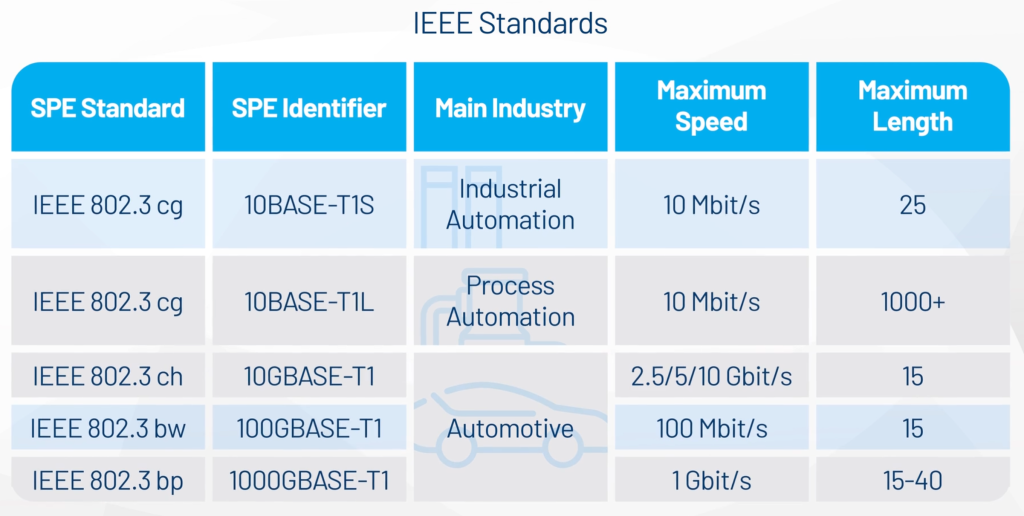
SPE Application Requirements
ODVA supports Single Pair Ethernet solutions that extend EtherNet/IP across applications and industries, including:
- Ethernet-APL for process automation field instruments in hazardous area
- Use 10BASE-T1L for long-haul Ethernet communication.
- Safely install devices in hazardous areas without complex calculations with 2-WISE.
- Potential reuse of existing Type A fieldbus cabling.
- Easier connectivity for legacy devices.
- EtherNet/IP In-Cabinet to bring low-level device connectivity to the Ethernet network
- Use 10BASE-T1S to connect simple devices like push buttons, contactors, lights, and more.
- More efficient cabinet build times.
- Gain valuable diagnostics from devices that were previously not directly connected to the network.
- General purpose SPE for discrete, non-hazardous factory environments
- Use 10BASE-T1L with Power over Data Line (PoDL) to enable higher powered devices and economical deployment in automotive and packaging
- Appropriate power classes and suitable connectors for machine automation

Why SPE Matters
EtherNet/IP using SPE is changing the enterprise networking strategy. It not only delivers on the promise of IIoT data but also reduces wiring complexity, weight, and cost for previously hard-to-connect areas. Connecting the unconnected helps process and discrete businesses improve their operational insights today and in the future.