


EtherNet/IP In-Cabinet
EtherNet/IP In-Cabinet utilizes 10BASE-T1S and a flat cable to connect contactors, push buttons, and motor starters to the Ethernet network. EtherNet/IP In-Cabinet enables reduced installation times via reduction in wiring that also provides sustainability benefits. Limitations including cost, available space, and power consumption have resulted in many edge devices remaining hardwired. However, a lack of network connectivity results in time consuming installation, challenging troubleshooting, and a deficiency of diagnostic information.
The steady decline in the cost and size of semiconductor chips combined with the availability of Single Pair Ethernet has enabled an EtherNet/IP in cabinet bus solution that uses a multidrop network and control power cable that spans a single cabinet with one interface per device and one switch port across multiple devices to reduce both commissioning and hardware cost.
EtherNet/IP In-Cabinet Multidrop Flat Cable Illustration
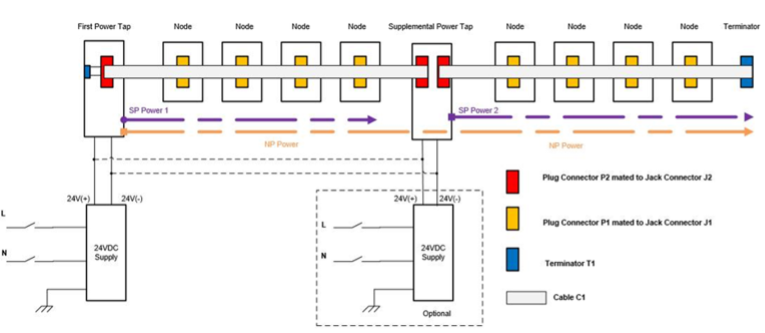
The inclusion of resource-constrained devices within cabinets on an EtherNet/IP network is made possible by low overhead UDP-only communication, a LLDP node topology discovery mechanism, auto-commissioning support, and auto-device replacement support. A new select line circuit facilitates the efficient delivery of system wide sequential commands, eliminates configuration switches by enabling topology discovery based on relative position, and allows for direct connection with programming tools during assembly for parameterization.
Select Line for EtherNet/IP In-Cabinet Bus System
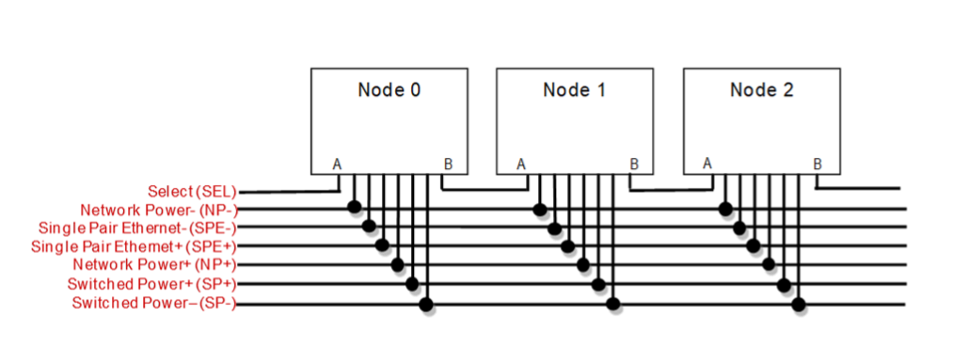
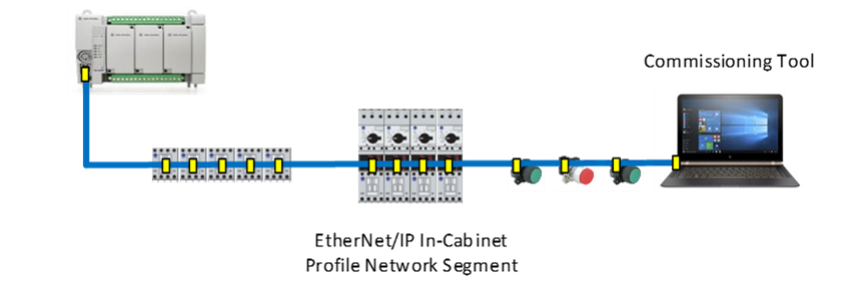
EtherNet/IP for in-cabinet resource-constrained devices will enable the benefits of additional diagnostics, asset information and parameterization capability, automatic node topology discovery, and plug and play device replacement compared to existing hard-wired devices. Single Pair Ethernet will enable the use of one seamless CIP network for both constrained and non-constrained devices. UDP-only EtherNet/IP communication and shared in-cabinet external power and communication cabling were designed to help increase installation return on investment.
EtherNet/IP In-Cabinet Profile Network Segment with Actual Topology Object in Controller (Commissioning Tool can also host Actual Topology Object)
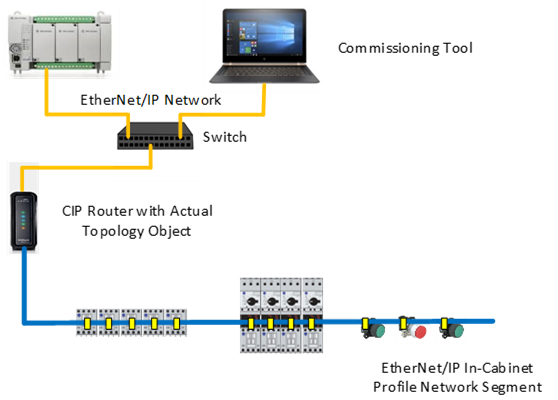
Expanding the connectivity of EtherNet/IP to include devices with the smallest physical footprint and most limited hardware resources opens up tremendous opportunity for further digital transformation within automation at the edge. The ability to obtain diagnostic, prognostic, and asset identity information remotely from more devices will drive down incidents of unplanned downtime and improve the efficiency of existing assets. The connection of resource-constrained devices to EtherNet/IP increases the value of existing networks for end users and reduces the need for secondary lower-level networks.
EtherNet/IP In-Cabinet Profile Network Segment with Actual Topology Object in Router
Click here to learn more about Single Pair Ethernet in the process industries via Ethernet-APL.